
Choosing the installer shapes your solar heater experience as much as choosing the model itself — maybe more. A great heater installed badly performs poorly, and a company that vanishes after the sale leaves you on your own the day something breaks. Here are 5 things to check before you pay any deposit, without naming or comparing specific competitors — the point is to know what to ask, whichever company you end up with.
Before the details, one plain fact is worth sitting with: most of the visible solar heater problems people complain about have nothing to do with the product itself — they trace back to a bad installation or a company that stopped answering the phone. So the real question isn't "is a solar heater any good," it's "who's installing it, and will they still be around next year." That distinction changes how you should shop: don't spend all your research time comparing model specs and none of it checking out the company behind them.
1. Is the product genuine and authorized, or a copy?
Ask about the authorized agent for the product and where it actually comes from. Genuine products carry a real manufacturer warranty; copies tend to show their weaknesses later — scale buildup, weak heating, repeat faults — right around when any warranty has run out, or never existed in the first place. If you want the practical signs to check with your own eyes during an inspection, there's a separate guide on telling a good solar heater from a poor one. And if you want to see how we handle this specific point, we've written about why Nobel specifically.
2. Is there an inspection before the final price?
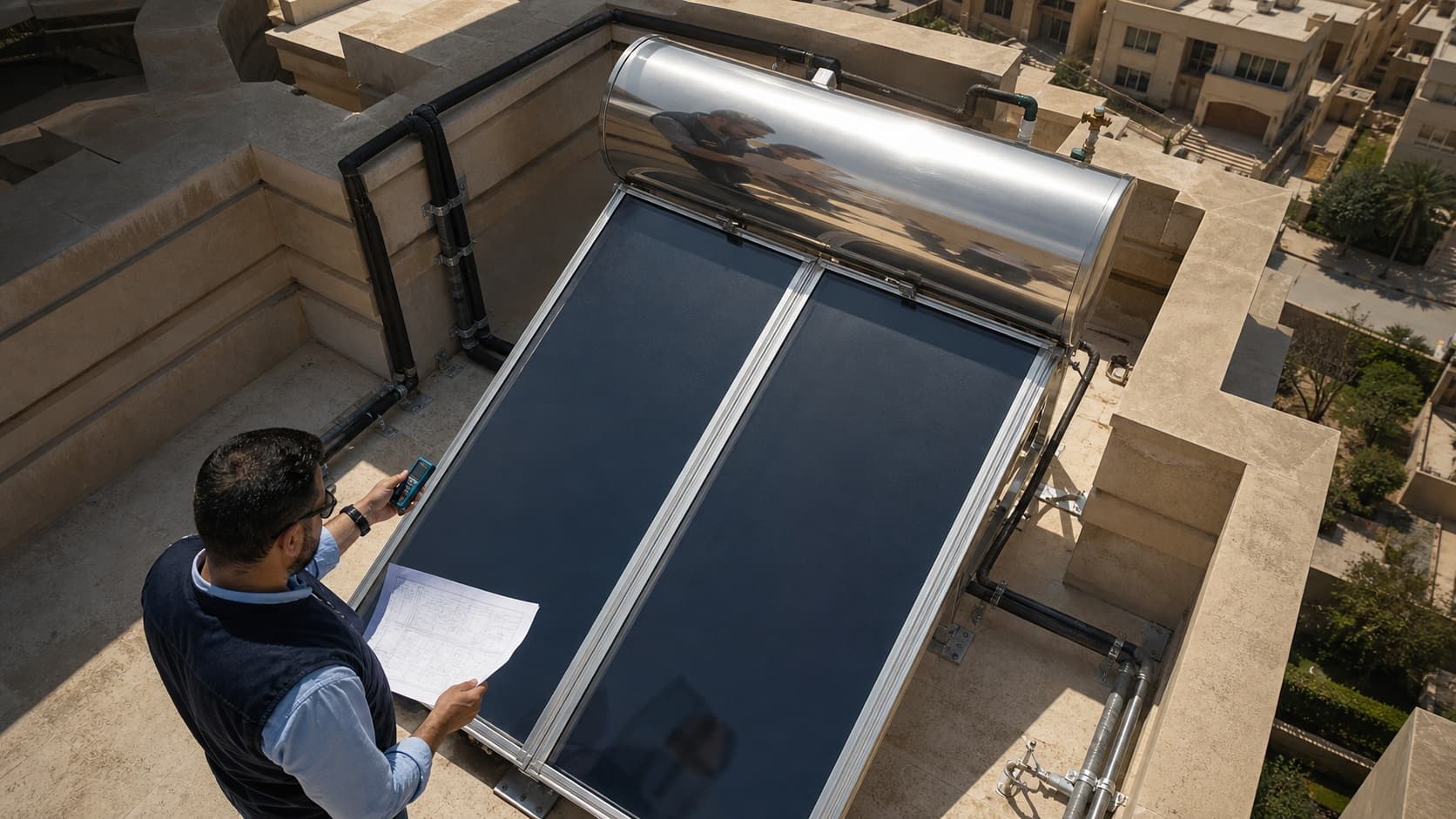
A serious company visits your roof and works out the right capacity and placement before giving you a final price — it doesn't sell the same model to every home. If someone quotes you a number over the phone without seeing your roof, that's a red flag. The inspection is also the right moment to ask about the best spot to install a solar heater on your specific building — a rooftop apartment isn't a villa, and a top floor isn't a ground floor, and both affect capacity and pipe runs.
Capacity itself is something a serious company calculates, not guesses. If you want a rough number before anyone visits, there's a simple tool that works out how many liters your solar heater should be based on your household size and usage.
3. Is the warranty written down, not just spoken
Ask: how long is the warranty, exactly what does it cover — the tank, the panels, the backup heating element — and where is that written: on an invoice or a formal contract, not a verbal promise made during the sales pitch. A company that's confident in its product won't hesitate to spell the warranty out in writing, and that's something you can verify for yourself at warranty activation right after installation.
The gap between "it's a one-year warranty" said quickly on a phone call, and "one year, written on the invoice, covering the tank and panels, signed" — that gap decides whether you can actually act on it if something fails, or whether you'll end up arguing over something nobody wrote down. Ask for a copy of the warranty before you sign anything, not after you've paid.
4. Does after-sales service actually exist
Ask: if something breaks after a year, who do you call? Companies that disappear after the sale save you money upfront and cost you more later — a spare part nobody knows how to fit, or a repair that takes weeks to schedule. The practical thing to check for is a clear maintenance service, ideally with a periodic maintenance option that keeps performance up before anything fails, plus an emergency maintenance line for the breakdown that happens at the worst possible time.
5. Ask to see real installations, not stock photos
Ask to see actual completed projects, not photos pulled off the internet. It's the fastest way to confirm the company has real field experience, not just a catalog. If you live somewhere with a lot of installations already — New Cairo or Sheikh Zayed, say — ask for examples close to your own neighborhood; that gives you a much better read on the roof and weather conditions you'll actually be dealing with, especially if you're in a villa with a different roof setup than the surrounding apartments.
What actually happens on installation day?
The gap between a professional crew and an average one shows up in the details that never make it into an ad. A professional team arrives with the right equipment, anchors the mounting frame to withstand wind, gets the tilt angle right for maximum sun exposure, and pressure-tests the connections before leaving — not just bolt it on and hand you an invoice. If the technician who shows up seems rushed, doesn't ask about your roof type or existing plumbing, or can't give you a straight answer on the warranty, that's a clear sign the real-world experience isn't there.
Another question worth asking during the inspection: who follows up with you after the first winter, once you want to confirm performance has held up? Companies with a real periodic-maintenance system answer that easily, because they already do it for other customers. Companies that dodge the question, or just say "don't worry, it'll be fine" with no specifics, usually don't have a real system behind that answer.
Why does this matter more than price?
A lot of people compare on the first quoted price alone, which is a reasonable instinct — but that number doesn't account for a breakdown a year later that nobody will fix, or a warranty that's unenforceable in practice. If you're still deciding whether the investment is worth it at all, there's a separate article that answers that with numbers: is a solar heater worth the cost? The short version: the payback only shows up when the installation is done right and the company sticks around — not just when the sticker price is low.
That connects to another question people ask before they've even decided: does it actually save money? For the real numbers on your bills over time, there's a separate breakdown of how much a solar heater saves — but that saving is directly tied to installation quality. A heater installed correctly saves roughly what you'd expect; one installed badly can run at a noticeably lower efficiency without you ever knowing why.
Warning signs you can spot from the first phone call
You don't have to pay first to find out a company is weak. Some signs show up early: pressure to decide today because "the offer ends tonight," refusing to give you anything in writing and insisting on verbal-only terms, or dodging the question the moment you ask about warranty details. These are all signs of a company built to sell fast and move on, not one building a long-term relationship with you. A company that's confident in its work isn't in a hurry, and answers your questions in detail instead of talking around them.
So what do I do now?
If you've decided to install a solar heater, start with a free inspection — you can judge any company against the 5 points above during that same visit, whichever one you choose. Book a free inspection or find your right capacity in a minute.
Frequently Asked Questions
What's the single most important thing to check before choosing an installer?
A formally written warranty (not a verbal promise) and real after-sales service — not just the lowest quoted price.
Should I trust a company that quotes a price over the phone with no inspection?
Better not to — every roof is different, and a serious quote only comes after someone has actually inspected it and worked out the right capacity.
Does Aurora meet these points?
Yes — Aurora is the exclusive agent for Nobel's European products in Egypt, with a free inspection, a comprehensive warranty, and real after-sales service.
How do I tell a good installer from a weak one on the first call?
Ask about the free inspection and the written warranty — if a company refuses either or dodges the question, that's reason enough to try another one.
Can a bad installation void the warranty?
In most cases, yes — real warranties usually require installation by an authorized team, which is one more reason to confirm who's doing the work before you pay.
Got a question about what you just read?
Talk to Aurora's team directly for a straight answer — or book a free site inspection if you're ready.